
Underwater Photography News, Reviews and Trip Reports from Optical Ocean Sales.
Tuesday, February 11, 2014
Palau: Photography in Paradise


Friday, November 1, 2013
Photo Expedition to the Socorros May, 2014!
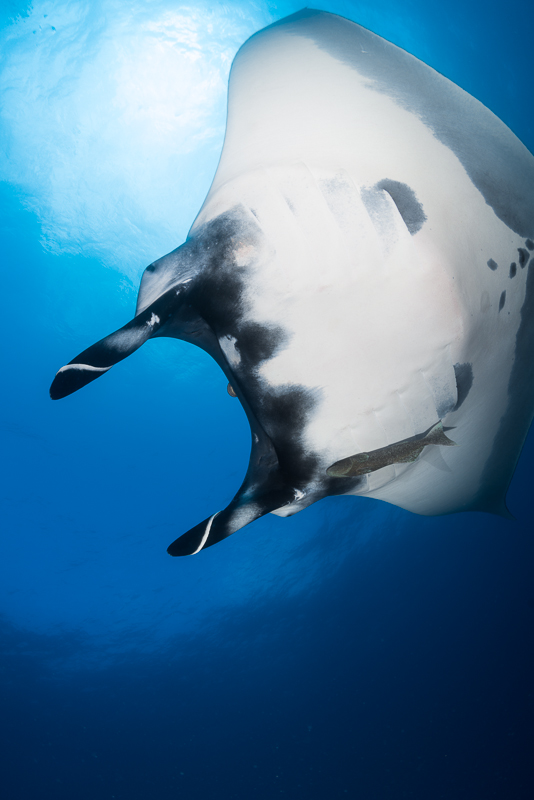 For those of you who enjoyed my photos and article on the Socorros Islands, please join us on a Photo Expedition there May 23- June 1st 2014.
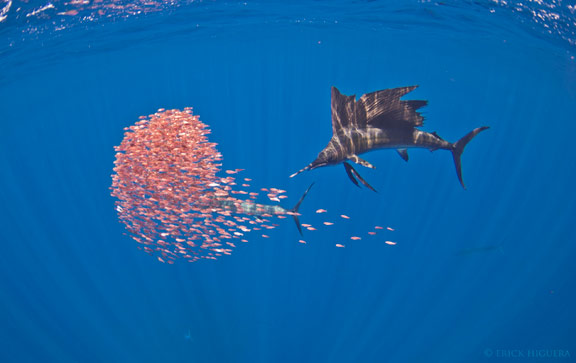
Optical Ocean Sales has organized a trip to go at a perfect time of year to find baitballs; schooling small fish that the predators encircle and feed on. These swirling “balls” of fish are attacked above and below water by sailfish, sharks, and dolphins - and are a mass of action for underwater photography.
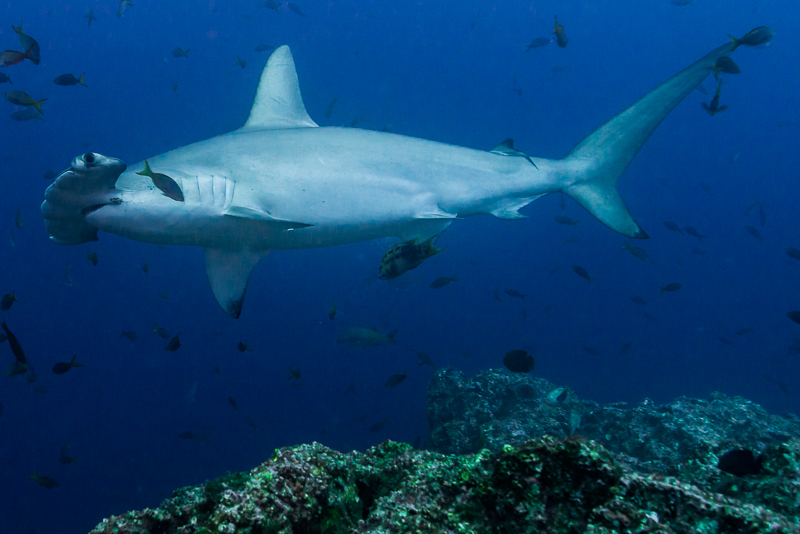
The Revillagigedos Islands, also known as the Socorro Islands, are located 250 miles offshore southwest of Cabo San Lucas, Mexico. They form an oasis for pelagic life amongst their volcanic shores. Many hammerhead and silky sharks, giant manta rays, dolphins, sailfish, schools of jacks and tuna come to feed, mate and get cleaned by small pandemic Clarion Angelfish.
This is also the time of year that huge schools of silky sharks are found at Roca Partida Island. These schools can literally block out the sun with their immense numbers.
 Our expedition will be on the Solmar V, a luxury liveaboard, which has been sailing these waters for many years, with probably the most experienced and friendly crew around. Best of all, our head guide will be Erick Higuera, a biologist and photographer, who just won the Beneath the Sea “Stan Waterman Award for Underwater Video” for his film “Baja”. He has worked for many years on the Solmar and has extensive experience in the islands.
Both Martin Heyn and myself will be on board and we plan on being available to help you get the most from this fantastic photo opportunity. The cost is $3395/$3495 and is all-inclusive; just get yourself to Cabo San Lucas and we do the rest! Our trip flyer is here. Get more details and sign up today at the webstore!
Friday, March 1, 2013
Blue Water Diving: It's All Good
 Went down to Cabo for a few days and then out on the Solmar V to the Soccoros for a week in mid-January. It can always be a crap shoot, and the last trip I made (this is my third) was in January and was spectacular. This time we had wind and cool weather in Cabo for most of the 5 days before the trip.
The islands really had gotten beat up with the hard rain and wind. Fortunately, it had improved as we left. Unfortunately the seas were choppy and the wind was still bad for the first couple of days. The viz, was pretty bad, worst I've seen, normally it's 80-100', but we had more like 20' horizontal and 40' vertical. We couldn't see our fins at Cabo Pearce. Frustratingly, there was pretty decent animal interactions, with lots of hammerheads and even a small Tiger at Canyons, but pretty much impossible to shoot!
Roca Partida had a bit better viz, but lumpy seas and strong currents. There was a small school of Galapagos sharks, but the group scared them away. Normally it's crystal clear and can have an amazing amount of animals.
Finally, we got back to San Benedicto and El Boiler was pretty good, although very hazy, pretty bad in the afternoon. But the mantas were playing and over the course of 8 dives I managed to get some images I liked, by getting within a few feet.
Oh well, that's blue water diving for you. The next couple of week's trip reports afterwards had the viz back and conditions excellent. The crew on the Solmar V is fantastic, the old boat still works out quite well, great food, huge camera table and everyone had fun.
We do have a charter in 2015 in March concentrating on shooting the humpback whales that migrate there then. I'll have an announcement up soon.
Here's a few shots. They were taken with a Nikon D800, Sigma 15mmFE, in a Nauticam NA-D800 housing and Zen 230mm dome port with 2x Sea & Sea YS-D1 strobes. This system is very easy to use underwater as it is neutral and fairly compact for it's capabilities.
Saturday, February 9, 2013
A Tale of Two Cameras: Photo Expedition to Taveuni and Rainbow Reef
 Fourteen brave folks came along on our first shop trip to Taveuni, Fiji this October. The long flights from LAX through Nadi to The Garden Island Resort went smoothly, and the friendly staff greeted us with warm welcomes and traditional songs. Our rooms were spacious, with fresh tropical flowers, and spa style bathrooms. We were anxious to get in a check-out dive right away, but the dive shop wasn’t prepared for our arrival, so things were bit disorganized. Having had a lot of experience in running dive trips, I was able to quickly get them back on track.
Diving the rest of the week went more smoothly, with two dives in the morning and one in the afternoon. Rainbow Reef, in the Somosomo Straits between Taveuni and Viti Levu was a short 20 min run out, and had a great variety of dive sites, from top-of-the-reef hard corals, sandy slots, to short/deep walls and caves. Currents were up and down, and really took the experienced guides to figure out. They would be running one way on one side of the reef and reverse direction on the other side. Many times we would drift down, then up and over and come back. The wall entrance to The Great White wall was a swim-through that started at 35’ and came out at 80’, then ended with another short swim-though from 65’ back to 30’. Our dive profiles were pretty zig-zaggy as a result, and it played havoc with some divers’ ears.
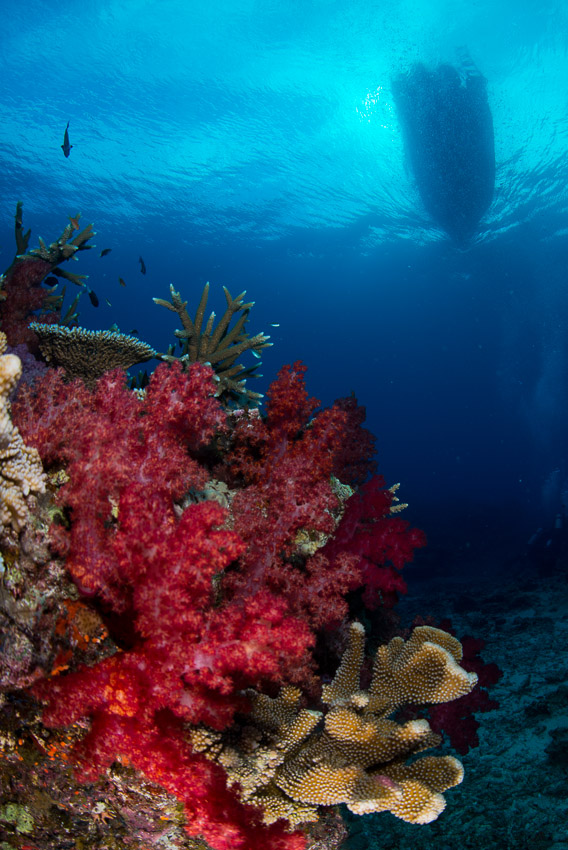
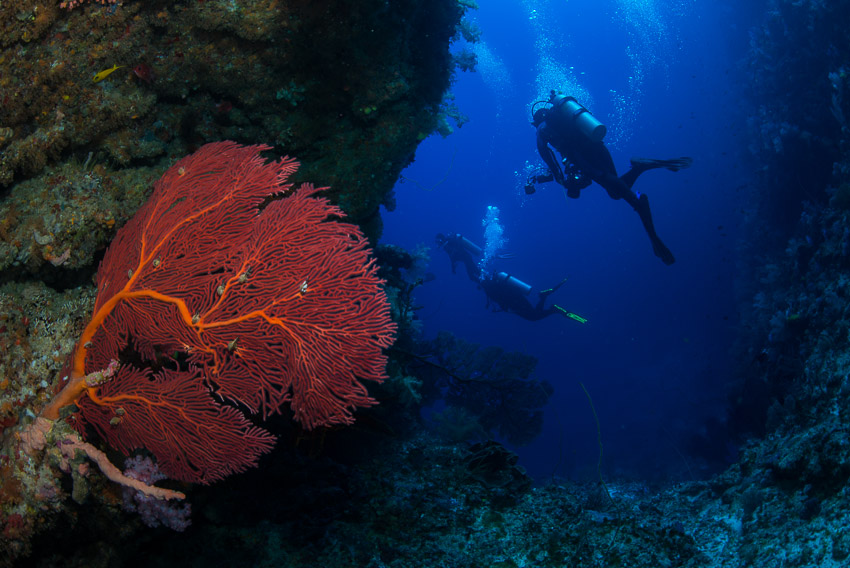
Fiji has amazing soft and hard corals, gorgonian fans and other invertebrates with Technicolor hues. These incredible vistas left all sorts of subject matter for photography. There are also large amounts of small and medium-sized fish, with a few larger ones wandering by from time to time; white-tip and bronze whaler sharks, a large napoleon wrasse, turtles, etc. The Somosomo Straits doesn’t have as many large animals as other spots, but there certainly is a variety of life.
Our surface intervals were a treat: we were able to pull up to a beautiful park on the other side of the straits that had a wide sandy beach and shady palm trees to take a quick nap under. Fresh coconuts that the guides broke open accompanied our snacks and clouds of small fish were fun to snorkel with.
Go Large or Go Home
While most photographers who travel are moving to smaller rigs I seem to be moving in the other direction. Having started with a small Sea & sea film rig, I moved through the range of Fuji compacts on to larger Nikon DSLRs. I was very happy with the size and performance of my Nikon D7000 until I had a chance to shoot a full-frame D800 camera. My feeling now is that I don’t mind the increased size if I can get better quality, a much broader dynamic range and have faster performance with better control. It’s all going to go in one bag anyway, so you might as well fill it!
 I had brought two complete Nauticam DSLR systems to Fiji, my trusty Nikon D7000 and a new D800 full-frame, thinking to try one against the other – size vs. performance. I also thought that the other folks might want to try one out. However, no one took me up on the offer; they all elected to stick with the cameras they brought with them.
 I had rented the D800 body and Sigma 15mmFE and heartily endorse the idea of renting a camera or specialty lens for a trip, especially if you aren’t sure what you want, or won’t use it very often. (I wanted to also look at the new D600 later on.) Moving from cropped-sensor DX to full-frame FX will entail changing several lenses, as most DX lenses simply don’t have enough resolution to use with a 36MP sensor. I plan on trying out professional quality lenses, and buying them only after I have enough experience to justify their expense.
I shot the D7000 the first day, with my usual Tokina 10-17 and then switched over to the D800, shooting with a Sigma 15mm fisheye lens, which for a relatively inexpensive lens is very sharp and focuses much closer than the 16mm Nikon FE. I later added a Kenko 1.4x teleconverter to the Sigma wide angle (while adding a 20mm extension) and really liked the magnified sharpness that the 21mm rectilinear format setup provided. You lose a little image area, but it seems to pull in and focus the fine details of the corals with less distortion at the corners.
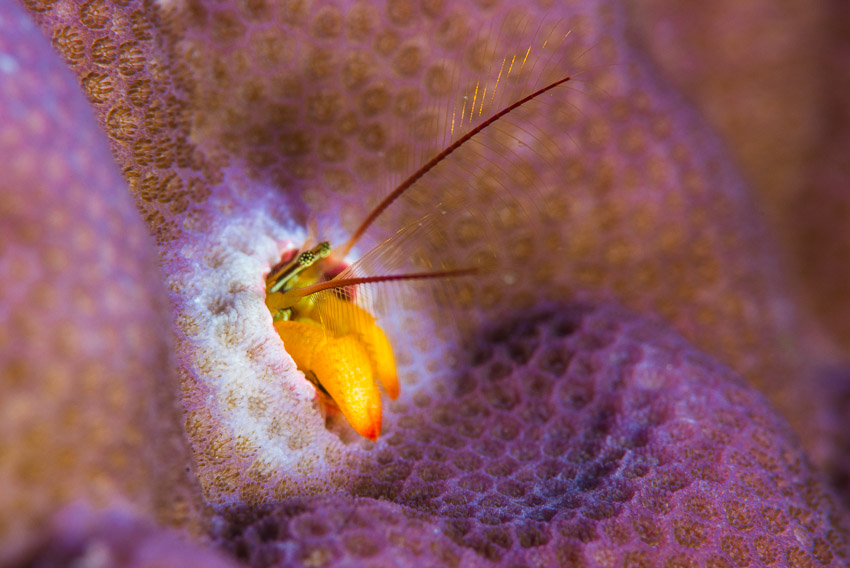
The 105VR macro shoots about like the 60mm macro does on DX, with a bit more reach, but subsequently it is harder to lock focus. I would recommend using at least a +5 diopter, maybe more, depending on what you want to shoot. This allowed me to get much closer and eliminate some water between the subjects and myself. I did find that it wouldn’t lock focus at distance on the D800, unlike using it on the D7000, where I like to shoot fish headshots.
 One unexpected bonus was how large and bright the full-frame viewfinders are. You not only get a third larger sensor, but you also get a third larger, 100% viewfinder!
 The difference in dynamic range, detail and overall image quality with the D800 was much greater than I expected on full-frame, and after reviewing the images on my computer, the D7000, while an amazing camera, just didn’t compare. All of a sudden this became an expensive dive trip!
Where the D7000 is nice and small, the D800 is more of a “voluptuous” size and weight. Surprisingly though, the D800 with an 8.5” dome port, was very light in the water, maybe even lighter than the D7000, while out of water it is a bit of a tank.
But a larger physical-sized rig has advantages. The Nauticam D800 has incredibly nice controls, many moved out to levers, they are spread out and fall right under my hands. Even better when using gloves in cold water. My favorite is the ISO: flip it down, scroll with the main control wheel and pop it back up. With the D7000, and most Nikons, if you select menu item “hold button until released”, it can work the same way, but with a push of a button instead of a lever. It saves having to use two hands to make an ISO or other change.
The one thing I really would miss from the D7000 is the small Zen 100mm dome port, along with the Tokina 10-17 FE zoom lens. You can really cram it into smaller spots when shooting CF/WA. With full-frame, you really have to shoot a larger dome, and I was using the 8.5” acrylic dome on this trip. The advantages of a larger dome are many: better corners and overall quality, the ability to use more wide-open f-stops and the ability to shoot over-and-unders. I would probably switch to a Zen 200mm or large 230mm mega-dome glass port for a little more crispness.
Getting used to shooting in high ISOs was the biggest change for me. It felt really “wrong” to use ISO 800 in the caves, as I’m so used to getting a lot of noise as a result. The D800 and other new FX cameras can be shot at very high ISOs without penalty. ISO 800 looks about like 200 on a DX camera and even higher ISO settings of 1200 or above show little noise. As I progress, I will find that shooting in available light, and maybe experimenting with filters at higher ISOs will be a huge sea-change and will open up a lot of new avenues for shooting shallow water, deeper wrecks, caves, or at night.
“Batting” It All Around
Every night at Taveuni we had hundreds of huge fruit bats come home to roost in the trees. Chirping, chattering and the occasional full screams accompanied our nights’ rest. Like the difference in technology between my cameras, the contrasts between the colorful soft corals and primal bats, the modern hotel in its eco-friendly surroundings and the primitive local houses, made for an interesting cultural experience.
D800 Photos:
D7000 Photos:
Tuesday, September 11, 2012
Purchasing a Mirrorless Camera System

There are some differences from buying a compact camera, mainly in terms of now having interchangeable lenses. You don't just switch from macro to wide angle with the one lens that's on the camera, you use different lenses and ports, and need to think through what kind of shots you're going to want to take while setting up the camera before a dive.
If you are going to buy a mirrorless camera, you are buying into a system. And that includes lenses, ports gears, tray/arms and strobes. The camera is going to end up being the least expensive part of it - and the part you are going to change out in a couple of years. You want to think about where you are going to be then in terms of what you can reuse and upgrade, and what the resale value is going to be like.
The Sony Nex5N is a great camera. There are very good wide angle options for it behind a dome port, and the lenses are fairly inexpensive. You just buy the 16mm and then add on the w/a or FE adapters to it. All three fit the Nauticam dome and you don't need a zoom gear. I would agree that the macro lenses are a bit limited, the 30mm hasn't worked out all that well underwater, but the wide angle shooting is very good.
 Panasonic m4/3rds cameras have some very good lenses and shoot excellent video. We have found their cameras to be fussy when when working in optical sync with external strobes, particularly TTL. They are also more expensive. But they have more direct controls and better specs in many cases.
Olympus has very easy-to-use cameras and reasonably priced lenses. The new Olympus OM-D EM-5 camera is making many people sell their big DSLRs and move to this small, high-quality camera with great specs and imaging. They are filling in some gaps in lens offerings with new ones like the 12-50mm which does offer the ability to go from macro to a moderate wide angle view with the right port. The cameras seem to work very well in manual and TTL sync with external strobes.
But really, I would almost consider the housing before the camera; The Olympus housings are inexpensive at $599-799ish, as are the cameras. But adding ports to them is expensive. Your best options are the Zen dome at $499-799, plus the lens. that port may/may not fit a new housing. Although they do seem like they'll fit the new Oly OM-D housings, that may not be true in the future. And they are limited to 135', have plastic construction, will wear out much sooner and need service or replacement. Resale values are going to be much less percentage-wise.
10Bar and some other lines make good value aluminum housings. They have a good lineup of ports and features including a depth rating of 200'. They come with a 2 year warranty and can be serviced in Hong Kong. Their controls and construction aren't as good as Nauticam, the ports not as specific to certain lenses. But they do seem to work well for many divers wanting to keep costs down. However resale values are pretty low.

The Nauticam housing for the OM-D ($1350) is very competitive with the Oly ($995) with all the above advantages. And you are much more likely to be able to resell it at a decent price, and re-use all the lenses, ports and gears when you upgrade.
All of these manufacturers are constantly upgrading their lines. The cycle used to be one year, but now it's 6 months! There's nothing really wrong with saving a bit on a camera that's 6 months old and spending it on a better housing too.
Lighting is the most critical thing you will spend money on. Buy more than you need, start with one good strobe and add another. We like the Sea & Sea YS-D1 strobe a lot - all of us are shooting it now.
So be sure to think through your new system, think though how you want to expand it and upgrade it in the future, and what you want to do with your photos. It may give you better ideas towards where you want to take your present purchase.
Optical Ocean Sales Has a New Website!

A Few New Features: New Home Page: Bright graphics greet and direct you to the main store pages. At the bottom, you'll find additonal information will help you including: Customer Care, and our all-new Education section (check out our new articles on the Panasonic G1X and YS-D1). You can also translate the site into several languages and currencies.
On our Graphic Categories Pages you'll find our new Housing and Port Locator. Just type in camera or lens to find recommended options.
Navigation is always available from the top tab "Shop Store" drop-down and left-hand Category menus on all pages.
Categories, Subcategories and Product Filters: All items are shown at the top level, then can be broken down by sub-categories, or by product filters. You can sort these results, or display them in 3 different modes. There is a "Quick View" of each item as you scroll over it.
We've updated product information and added hundreds of new, up-to-date items, with a "What's New" category of highlights. We've greatly expanded and updated our "System Packages" and added SEACAM offerings as examples. You'll find photographs, details, product options, prices and tabs with additional information on the Product Pages. There is a personal "Wish List" that you can add products to.

You can log into your account to see orders and open an order communication with us.
Wow! Too many improvements to even show you. Just visit the store today and try them all out!
Saturday, April 14, 2012
Optical Ocean Sales Becomes SEACAM Dealer
 SEACAMUSA, the exclusive North and South American distributor for SEACAM underwater housings and submersible strobes, is proud to announce the appointment of Optical Ocean Sales as a SEACAM dealer.
In recognition of their 9-years service to the local Northwest diving community and the passion for underwater photography by owner Jack Connick, SEACAMUSA owner Stephen Frink comments “We are very pleased to have Jack and his staff as members of the SEACAM team. We welcome their expertise and commitment to customer service to underwater photography in general, and the SEACAM product line in particular. We look forward to making SEACAM available to ever more consumers by their regional presence and contagious enthusiasm”.
 Optical Ocean Sales retail showroom is located in Seattle, Washington, the only dedicated underwater photography equipment store in the Northwest. But their reach extends far beyond, with their online e-commerce store. Jack Connick has been a life-long photographer, with experience including over 25 years of experience as a professional graphic designer, art director, and underwater photographer. He has extensive diving and photographic experience, both in the tropics and in his cold home waters in the Pacific Northwest.
SEACAM is a premium line of aluminum housings and strobes designed and built in Austria by Harald Hordosch. Known for their quality optics, superb ergonomics, and robust performance; SEACAM is the brand preferred by professional photographers and discerning enthusiasts around the world.
For more information contact Optical Ocean Sales, LLC at 1800 Westlake Ave N., Suite 201, Seattle, WA 98119; or by phone at 1-800-359-1295 or 206-284-1142. Contact via OpticalOceanSales.com and email
Saturday, March 17, 2012
Focus Lights Beam Test
 We conducted a beam test of most of the lights in our current focus and video light inventory recently. Lights from Light & Motion, iTorch, Big Blue, Fantasea and others were tested, setting them at a fixed position and a 5' distance from a wall, then photographing them at a set exposure and lens position. This is NOT a scientific test, but should give a good relative idea of the strength, beam width and evenness of the lights' output.
Download a .pdf file here with links to each light.
Expand to full screen and turn on "Show Info" to see names of lights.
Subscribe to:
Posts (Atom)